Monday, March 21, 2011
Saturday, March 5, 2011
Astrology is wrong
..as above, so below...
"It should not be considered unbelievable that one can retrieve useful knowledge and sacred relics from astrological folly and godlessness. From this filthy mud one can glean even an occasional escargot, oysters or an eel for one's nutrition; in this enormous heap of worm-castings there are silk-worms to be found; and, finally, out of this foul-smelling dung-heap a diligent hen can scratch up an occasional grain-seed -- indeed, even a pearl or a gold nugget." --Johannes Kepler
Astrology, in its traditional form, is a type of divination based on the theory that the positions and movements of celestial bodies (stars, planets [except the one you are born on or those in other solar systems], Sun, and Moon) at the time of birth profoundly influence a person's life. Some forms of astrology claim that terrestrial events such as natural disasters are predicted by various celestial arrangements or events. Given the innumerable relationships of celestial items, it would be surprising if one could not find some correlation between earthly events like tornadoes, volcanic eruptions, earthquakes, hurricanes, droughts, fires, etc., and an arrangement of planets in relation to the Sun or Moon. Correlation does not prove causality, but it is good enough for most astrologers. (For a classic example of this kind of reasoning, see Valerie Livina's blog. She has sent me several e-mails about things like a full solar eclipse viewable from China in July 2009 and stories about earthquakes in Japan the following month. "Do you still think it is just a coincidence?" she asked. Yes, I do. We call this the post hoc fallacy in my neighborhood.)
In its psychological form, astrology is a type of New Age therapy used for self-understanding and personality analysis (astrotherapy). In all forms, astrology is a manifestation of magical thinking.
Ivan Kelly, who has written many articles critical of astrology, thinks that astrology
has no relevance to understanding ourselves or our place in the cosmos. Modern advocates of astrology cannot account for the underlying basis of astrological associations with terrestrial affairs, have no plausible explanation for its claims, and have not contributed anything of cognitive value to any field of the social sciences.
Even so, astrology is believed by millions of people and it has survived for thousands of years. The ancient Chaldeans and Assyrians engaged in astrological divination some 3,000 years ago. In India, astrology has been practiced for at least two millennia. Known as Jyotisa, it and several variations such as Nadi astrologyare still widely practiced in India where reincarnation is a prominent belief. The light from the heavens supposedly affects each incarnation and these systems of astrology claim to be able to discern useful information for guiding a person through his or her current life.
By 450 BCE the Babylonians had developed the 12-sign zodiac, but it was the Greeks--from the time of Alexander the Great to their conquest by the Romans--who provided most of the fundamental elements of modern Western astrology. The spread of astrological practice was checked by the rise of Christianity, which emphasized divine intervention and free will. During the Renaissance, astrology regained popularity, in part due to rekindled interest in science and astronomy. Christian theologians, however, warred against astrology, and in 1585 Pope Sixtus V condemned it. At the same time, the work of Kepler and others undermined astrology’s tenets.Its popularity and longevity are, of course, irrelevant to the truth of astrology in any of its forms.
Astrology was also adopted in ancient Persia and throughout the Arab world where it was taken up by Muslims whose work found its way to Europe during the Renaissance.*
The ancient Chinese adopted an elaborate and intricate system of astrology that is intimately connected with various metaphysical notions such as yin and yang and wu xing. Many Westerners are familiar with the cycle of the twelve Zodiac animal signs in Chinese astrology, e.g., the year of the rat, ox, tiger, rabbit, dragon, snake, etc.
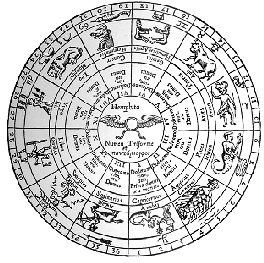
The most popular form of traditional Western astrology is sun sign astrology, the kind found in the horoscopes of many daily newspapers. A horoscope is an astrological forecast. The term is also used to describe a map of the zodiac at the time of one’s birth. The zodiac is divided into twelve zones of the sky, each named after the constellation that originally fell within its zone (Taurus, Leo, etc.). The apparent paths of the Sun, the Moon, and the major planets all fall within the zodiac. Because of the precession of the equinoxes, the equinox and solstice points have each moved westward about 30 degrees in the last 2,000 years. Thus, the zodiacal constellations named in ancient times no longer correspond to the segments of the zodiac represented by their signs. In short, had you been born at the same time on the same day of the year 2,000 years ago, you would have been born under a different sign.
In fact, there should be 13 signs, not 12.
Precession of the equinox is caused by the fact that the axis of the Earth's rotation (which causes day and night) and the axis of the Earth's revolution around the Sun (which marks the passage of each year) are not parallel. They are 23 1/2 degrees away from lining up; that is, the Earth's axis of rotation is tilted. This tilt also causes our seasons, a fact that Ptolemy did understand but that many people do not understand even today. Ptolemy understood that the rotation axis of the Earth was slowly precessing, or moving in a circle, with an angular radius of 23 1/2 degrees with a period of around 26,000 years. He deduced this from comparisons of data taken by the ancient Sumerians 2,000 years before his time. He did not understand what was pushing the precession, but he did understand the motion. We now realize that the Sun is rotating with a period of around 30 days and that this causes the Sun to bulge at the equator, which causes a torque to be exerted on the top like motion of the Earth's day and night cycle. There is also a small 18.6-year variation caused by the Moon's orbit around the Earth, and the Moon also has a small effect on precession; however, the Sun's equatorial bulge is the main cause of the precession of the equinox, which is why your sign listed in the newspaper, by Sidney Omar for instance, in most cases is removed by one sign from the modern, actual position of the Sun at your birth.
The modern signs as listed here are further complicated when their boundaries are those of the current constellations. A neater way of dividing the signs would be to divide the ecliptic into 30-degree slices, as Ptolemy did, but to keep the slices centered on the star patterns. This would make the time interval for the signs more nearly 30 days each and eliminate the [13th] sign of Ophiuchus [off ee oo' kus], but your modern sign would still differ by one sign from the tradition designations.*
tropical and sidereal astrology
Traditional Western astrology may be divided into tropical and sidereal. (Astrologers in non-Western traditions use different systems.) The tropical, or solar, year is measured relative to the Sun and is the time between successive vernal equinoxes (365 days, 5 hr, 48 min, 46 sec of mean solar time). The sidereal year is the time required for the Earth to complete an orbit of the Sun relative to the stars (365 days, 6 hr, 9 min, 9.5 sec of mean solar time). The sidereal year is longer than the tropical year because of the precession of the equinoxes, i.e., the slow westward shift of the equinoctial points along the plane of the ecliptic at a rate of 50.27 seconds of arc per year, resulting from precession of the Earth’s axis of rotation.
Sidereal astrology uses the actual constellation in which the Sun is located at the moment of birth as its basis; tropical astrology uses a 30-degree sector of the zodiac as its basis. Sidereal astrology is used by a minority of astrologers and bases its readings on the constellations near the Sun at the time of birth.
Tropical astrology is the most popular form and it assigns its readings based on the time of the year, while generally ignoring the positions of the Sun and constellations relative to each other. It is based on the work of Ptolemy.
Ptolemy had available the resources of the vast library at Alexandria ... and produced two major text books which were to become the mainstay of astronomical and astrological thinking for the next 1500 years. The astrological text was known as the Tetrabiblos (also known as the Quadrapartitium, or Four Books), which summarized all the astrological work produced in the past by Mesopotamians and Greeks.... Among other things it helped establish the Tropical zodiac as the zodiac of the west on the basis of Ptolemy’s argument that the zodiac should be tied to the seasons rather than to the constellations.* [note: For easier reading of this source, if you're using Firefox or Explorer, either highlight the text to read it or select no style under View>(Page) Style.]
According to some astrologers, the data support the hypothesis that there is a causal connection between heavenly bodies and human events. Appeals are made to significant correlations between astrological signs and such things as athleticism. However, a statistically significant correlation between x and y is not a sufficient condition for reasonable belief in a causal connection, much less for the belief that x causes y. Correlation does not prove causality; nevertheless, correlations are extremely attractive to defenders of astrology. For example: “Among 3,458 soldiers, Jupiter is to be found 703 times, either rising or culminating when they were born. Chance predicts this should be 572. The odds here: one million to one” (Gauquelin 1975). Let’s assume that the statistical data show significant correlations between various planets rising, falling, and culminating, and various character traits. It would be more surprising if of all the billions and billions of celestial motions conceivable, there weren’t a great many that could be significantly correlated with dozens of events or individual personality traits.
Defenders of astrology are fond of noting that ‘the length of a woman’s menstrual cycle corresponds to the phases of the Moon’ and ‘the gravitational fields of the Sun and Moon are strong enough to cause the rising and falling of tides on Earth.’ If the Moon can affect the tides, then surely the Moon can affect a person. But what is the analog to the tides in a person? We are reminded that humans begin life in an amniotic sea and the human body is 70 percent water. If oysters open and close their shells in accordance with the tides, which flow in accordance with the electromagnetic and gravitational forces of the Sun and Moon, and humans are full of water, then isn’t it obvious that the Moon must influence humans as well? It may be obvious to some, but the evidence for these lunar effects is lacking.
Astrologers emphasize the importance of the positions of the Sun, Moon, planets, etc., at the time of birth. However, the birthing process isn’t instantaneous. There is no single moment that a person is born. The fact that some official somewhere writes down a time of birth is irrelevant. Do they pick the moment the water breaks? The moment the first dilation occurs? When the first hair or toenail peeks through? When the last toenail or hair passes the last millimeter of the vagina? When the umbilical cord is cut? When the first breath is taken? Or does birth occur at the moment a physician or nurse looks at a clock to note the time of birth?
Why are the initial conditions more important than all subsequent conditions for one’s personality and traits? Why is the moment ofbirth chosen as the significant moment rather than the moment ofconception? Why aren’t other initial conditions such as one’s mother’s health, the delivery place conditions, forceps, bright lights, dim room, back seat of a car, etc., more important than whether Mars is ascending, descending, culminating, or fulminating? Why isn’t the planet Earth—the closest large object to us in our solar system--considered a major influence on who we are and what we become? Other than the Sun and the Moon and an occasional passing comet or asteroid, most planetary objects are so distant from us that any influences they might have on anything on our planet are likely to be wiped out by the influences of other things here on Earth.
No one would claim that in order to grasp the effect of the Moon on the tides or potatoes one must understand initial conditions of the Singularity before the Big Bang, or the positions of the stars and planets at the time the potato was harvested. If you want to know what tomorrow’s low tide will be you do not need to know where the Moon was when the first ocean or river was formed, or whether the ocean came first and then the Moon, or vice-versa. Initial conditions are less important than present conditions to understanding current effects on rivers and vegetables. If this is true for the tides and plants, why wouldn’t it be true for people?
Finally, astrology is probably the most widely practiced superstitionand most popular Tooth Fairy science in the world today. Nevertheless, there are many who defend astrology by pointing out how accurate professional horoscopes are. Astrology “works,” it is said, but what does that mean? Basically, to say astrology works means that there are a lot of satisfied customers. There are a lot of satisfied customers because thanks to subjective validation, it is easy to shoehorn any event to fit a chart. To say astrology "works" does not mean that astrology is accurate in predicting human behavior or events to a degree significantly greater than mere chance. There are many satisfied customers who believe that their horoscope accurately describes them and that their astrologer has given them good advice. Such evidence does not prove astrology so much as it demonstrates the Forer effect and confirmation bias. Good astrologers give good advice, but that does not validate astrology. (They also make ambiguous claims like the oracle of Delphi who told Croesus before he attacked Persia: “If you cross the river, a great empire will be destroyed.” So armed, Croesus attacked, resulting in the destruction of his own empire.) There have been several studies that have shown that people will use selective thinking to make any chart they are given fit their preconceived notions about themselves and their charts. Many of the claims made about signs and personalities are vague and would fit many people under many different signs. Even professional astrologers, most of whom have nothing but disdain for sun sign astrology, can’t pick out a correct horoscope reading at better than a chance rate. Yet, astrology continues to maintain its popularity, despite the fact that there is scarcely a shred of scientific evidence in its favor. Even the former First Lady of the United States, Nancy Reagan, and her husband, Ronald, consulted an astrologer while he was the leader of the free world, demonstrating once again that astrologers have more influence than the stars do.
Sourced from http://skepdic.com/astrology.html
. Copied for informational purposes only, no breach of copyright intended.

Wednesday, March 2, 2011
Celestron 14" Schmidt-Cassegrain telescope


The CGE-1400 Schmidt-Cassegrain Telescope is part of Celestron's “Top-of-the-Line” German Equatorial mounted astronomical telescopes. With over three times the light gathering power of an 8” telescope, this observatory-class instrument is Celestron's largest optical system in its class. This model features our standard StarBright coatings.
This telescope is especially at home as a solid platform for long exposure photography with optional CCD cameras or photographic equipment; it is a serious scientific research tool. German Equatorial mounts are recognized as being the superior choice for astrophotography because of their rock solid stability, simple balancing easy accessibility for attaching equipment. With sophisticated software features like Hibernate function, the CGE can maintain its star alignment night after night without needing to be re-aligned, making it an ideal instrument for a permanent observatory facility.
The CGE 1400 takes full advantage of its vast database of thousands of NGC and Abell galaxies as well as delivering a new level of detail to all your favorite deep sky objects. Turn this scope to the planets and see amazing detail on the surface of Jupiter; see Cassini's Division in the rings of Saturn, and resolve details on the surface of Mars. Even the distant Uranus, Neptune and Pluto are within your reach.
In addition to being fully computerized with a database of over 40,000 celestial objects, the CGE German Equatorial mount offers numerous design advantages:
Portability – Set up and transportation of the CGE telescopes is made easy by separating the CGE instruments into smaller, easy-to-carry components. Unlike fork arm mounted telescopes, the CGE's optical tubes can be quickly removed from their mounts making even the CGE 1400 easily assembled by only one person.
Stability – Recognized for superior stability, German Equatorial mounts place the center of gravity directly over the tripod legs and can be easily polar aligned without the use of an optional equatorial wedge. This proven design reduces the “tuning fork” vibration that can be associated with undersized fork mounts. An improved Super HD Tripod supports the CGE mount. This fully extendable tripod is made from the finest cold rolled carbon steel and can be raised to a height of 50". The tripod uses a dual leg support for maximum rigidity with an upper leg brace to provide an outward preload and a lower leg brace providing inward tension.
Balance – CGE equatorial mounts can easily be balanced in both axes. Simply sliding the counterweight for Right Ascension and moving the optical tube along its dovetail mounting for Declination accomplish balancing the weight of camera equipment and other visual accessories. This means that no additional weight needs to be added to balance the telescope when additional accessories are added.
Clearance – CGE mounts support their tubes at a single contact point allowing the tube to move freely around its polar axis without making contact with the telescope's mount. This is particularly useful when adding photographic and CCD instruments that extend from the rear of the telescopes.
All CGE mounted telescopes are compatible with Celestron's CN-16 GPS accessory. Combine the GPS and built-in Hibernate mode and these telescopes will keep track and remember their exact location and time without having to enter the information into the hand control.
CGE 1400 - General Features
- 14" Schmidt-Cassegrain telescope
- Observatory-class computerized German Equatorial mount
- Schmidt-Cassegrain mechanism that moves the primary mirror to adjust focus is supported by two pre-loaded ball bearings, minimizing the "mirror flop" typical of bushing focus mechanisms
- Celestron's standard StarBright coatings
- 9x50 finderscope to help accurately find objects
- Cold rolled carbon steel tripod legs provide extremely stable platform
- Star diagonal provides more comfortable viewing position when observing objects that are high in the sky
- 40,000 object database with over 100 user-definable objects and expanded information on over 200 objects
- Proven NexStar computer control technology
- GoTo system is precision accurate to 1.5 arcminutes
- Software Features include: Compass Calibration, Polar Alignment routine, Database Filter Limits, Hibernate, Auto North and Level, Quick Align, and user-defined slew limits
- Flash upgradeable hand control software and motor control units for downloading product updates over the Internet
- Custom database lists of all the most famous deep-sky objects by name and catalog number; the most beautiful double, triple and quadruple stars; variable star; solar systems; objects and asterisms
- Permanent programmable periodic error correction (PEC) - corrects for periodic tracking errors inherent to all worm drives
- Precision Bronze Worm Gear - 32 pitch, 5.625" pitch diameter, 180 tooth bronze gear manufactured in the U.S.A. by W. M. Berg, Inc. Manufactured to AGMA Quality Class 10 standard, which minimizes total composite error and backlash.
- Drive Motors - Made in the U.S.A., Pittman® LO-COGT brush-commutated DC motors offer smooth, quiet operation and long life. The motor armatures are skewed to minimize cogging which is required for low speed tracking.
- Bearing and Shaft - Stainless steel worm shaft has 0.4375 pitch diameter and is preloaded with two ball bearings. The worm is made from a single piece of steel (rather than a two-piece worm-and-shaft assembly) to minimize run-out, which is a source of PE
- 12VDC Servo Motors with integrated optical encoders with 0.11 arcsecond resolution
- No-slip clutch system for pointing precision
- Autoguide port, PC port and auxiliary ports located on the electronic pier for long exposure astrophotography
- Double line, 16-character Liquid Crystal Display Hand Control with backlit LED buttons for easy operation of goto features
- RS-232 communication port on hand control to control the telescope via a personal computer
- Includes NexRemote telescope control software, for advanced control of your telescope via computer
- GPS-compatible with optional CN16 GPS Accessory (93967)
Wednesday, February 16, 2011
What Causes Auroras?
People who live at high latitudes, either northern or southern, often enjoy watching brilliantly hued auroral displays. Near the north pole they are called the aurora borealis or northern lights. Near the south pole they are called the aurora australis or southern lights. The aurora are most commonly visible near the poles, but they are on rare occasions also visible at mid-latitudes.
What causes colorful auroral displays?
Physics and Causes of the Aurora
High speed energetic particles collide with atoms in Earth's atmosphere at a height of anywhere from about 50 to a few hundred miles above Earth's surface to cause the aurora. These high speed particles, which are usually electrons, originate from space, specifically from the solar wind, blowing outward from the Sun.
When the electrons from space strike an atom or molecule in Earth's atmosphere, they give one of the electrons in the atom an energy boost. In scientific jargon, the electron jumps to a higher energy level and the atom is in an excited state. After a while, the electron in the excited atom jumps back down to its original lower energy level. It releases this energy as light causing the auroral glow. This process is the same mechanism that causes emission line spectra and aurora are in fact emission line spectra of the atoms in Earth's upper atmosphere.
The color of emission line spectra depends on the chemical composition, and each type of atom produces its own unique pattern of colors. Hence, the different colors in auroral displays originate from different elements in Earth's atmosphere.
Oxygen molecules cause the green Aurora, and oxygen atoms cause the red colors. Blue auroral displays result from nitrogen molecules. Molecular nitrogen and oxygen are the most common constituents of Earth's atmosphere, so these are the most common auroral colors. Atomic oxygen occurs at high altitudes, so aurora usually have red above the green. Mixtures of these colors form other colors.
Why are Aurora Most Visible near the Poles?
In a magnetic field, electrons and other charged particles do not travel in a straight line. Instead the magnetic force causes the electrons to travel in a spiral path around magnetic field lines. The electrons therefore enter Earth's atmosphere near the north and south magnetic poles, which are near the geographic poles. Hence the aurora are most visible near the polar regions. They are only visible at lower latitudes when there is an extremely high level of solar activity hurling electrons towards Earth.
When Are Aurora Most Visible?
It must be dark to see the aurora, so they are more likely to be visible during the winter months when nights are longer. This effect is greater at high latitude. In the summer, nighttime darkness is almost nonexistent at polar latitudes, so it is correspondingly more difficult to see aurora, even though they do occur.
Aurora are also related to space weather activity. When the Sun is more active it throws more electrons towards Earth. Extreme solar storms usually cause extreme auroral displays, which are often visible at lower latitudes.
Solar activity usually follows an 11 year cycle, so aurora are more common during the peaks of this cycle and rare during the valleys of this solar cycle. The years 2008 and 2009 should have marked the beginning of a new cycle. At this writing, however, the new activity cycle does not yet seem to have started.
People living and tourists vacationing at high latitudes should take the time to go out at night and look for the aurora. The southern and northern lights are among nature's most impressive displays.
Friday, December 31, 2010
Astronomical Events of 2011
- Peak Date = May 6


Get Set Go! Quadrantids 2011
For AFA's previous detailed post on the Quadrantids, and to know in detail about the meteor shower, please visit this link.
QUADRANTIDS METEOR SHOWER 2011
Active Start Date - 1st January
Active End Date - 10th January
Peak Date - 3rd and 4th January
Maximum Activity - January 4, 1h 10m UTC i.e. 6:40 am IST
Timings for India - Best Time to Observe is from 11:00 pm to 4:30 am on January 3-4. Look for the pole star in the North. Pole Star to be visible from 8:30 pm onwards on January 3, and Bootes (the radiant) will be visible from about 10:30 pm onwards. Try to get away from cities for the best loacation!
The Association of Friends of Astronomy (Goa) is planning a 'Official' overnight observation for the Quadrantids Meteor Shower 2011.
Thursday, December 30, 2010
Quadrantids Meteor Shower 2011 - Info and Timings for India
Quadrantids, the first major astronomical event of the calendar year 2011, is set to take center stage. It is all set to happen on 4th January, the peak date of the shower, all around the world. The Moon gives way (New Moon) and for once, Jupiter's might will be ignored and the whole world will train their eyes on Bootes and the Pole Star.
For starters, for an idea and basic info about a meteor shower, please visit this webpage.

For many meteor showers it is often recommended to look straight up, but for this year’s Quadrantids it is advised that observers face as low as possible toward the horizon without being looking at the ground. In Goa and the rest of India, it is advised to look North-East near the Horizon, for the Pole Star will be visible from 8:30 pm and Bootes will be visible from 12 am onwards. Meteors will grab your attention as they streak by!
Given here are the timings for the Meteor Shower in India. For viewing times in other countries, please visit Spacedex. The Best Time to Observe the meteor shower in India is from 11 pm to 4:30 am Indian Standard Time on January 3 and 4. But remember, meteors will be visible from January 1 to 10. So keep watching!
Here is a past video of the Quadrantids in 2010. Sourced from Youtube.
The Association of Friends of Astronomy (Goa) has also planned an overnight observation at the Public Astronomical Observatory. This being a public event, the general public is welcome to pay
visit to the observatory and be a part of the ongoing observations!
