The Quadrantids are in sight. The timings have been digested. All we can do now is wait and watch for the best! This post is a successor to the previous one on the Quadrantids. While the previous post had lot of detail, this post will even out the facts.
For AFA's previous detailed post on the Quadrantids, and to know in detail about the meteor shower, please visit this link.
QUADRANTIDS METEOR SHOWER 2011
Active Start Date - 1st January
Active End Date - 10th January
Peak Date - 3rd and 4th January
Maximum Activity - January 4, 1h 10m UTC i.e. 6:40 am IST
Timings for India - Best Time to Observe is from 11:00 pm to 4:30 am on January 3-4. Look for the pole star in the North. Pole Star to be visible from 8:30 pm onwards on January 3, and Bootes (the radiant) will be visible from about 10:30 pm onwards. Try to get away from cities for the best loacation!
The Association of Friends of Astronomy (Goa) is planning a 'Official' overnight observation for the Quadrantids Meteor Shower 2011.
Showing posts with label meteor. Show all posts
Showing posts with label meteor. Show all posts
Friday, December 31, 2010

Thursday, December 30, 2010
Quadrantids Meteor Shower 2011 - Info and Timings for India
This post by The Association of Friends of Astronomy (Goa) will deal with information, viewing times for India and locations for the Quadrantids Meteor Shower 2011, a "shooting" treat for amateur astronomers and everyone who has looked up in the majestic sky.
Quadrantids, the first major astronomical event of the calendar year 2011, is set to take center stage. It is all set to happen on 4th January, the peak date of the shower, all around the world. The Moon gives way (New Moon) and for once, Jupiter's might will be ignored and the whole world will train their eyes on Bootes and the Pole Star.
For starters, for an idea and basic info about a meteor shower, please visit this webpage.


For many meteor showers it is often recommended to look straight up, but for this year’s Quadrantids it is advised that observers face as low as possible toward the horizon without being looking at the ground. In Goa and the rest of India, it is advised to look North-East near the Horizon, for the Pole Star will be visible from 8:30 pm and Bootes will be visible from 12 am onwards. Meteors will grab your attention as they streak by!
Given here are the timings for the Meteor Shower in India. For viewing times in other countries, please visit Spacedex. The Best Time to Observe the meteor shower in India is from 11 pm to 4:30 am Indian Standard Time on January 3 and 4. But remember, meteors will be visible from January 1 to 10. So keep watching!
Here is a past video of the Quadrantids in 2010. Sourced from Youtube.
The Association of Friends of Astronomy (Goa) has also planned an overnight observation at the Public Astronomical Observatory. This being a public event, the general public is welcome to pay
visit to the observatory and be a part of the ongoing observations!
Quadrantids, the first major astronomical event of the calendar year 2011, is set to take center stage. It is all set to happen on 4th January, the peak date of the shower, all around the world. The Moon gives way (New Moon) and for once, Jupiter's might will be ignored and the whole world will train their eyes on Bootes and the Pole Star.
For starters, for an idea and basic info about a meteor shower, please visit this webpage.
The Quadrantids is the very first meteor shower of the year, and is known to be one of the strongest - producing fireballs and meteors that are exceptionally bright. If the sky is clear enough, expect to see meteors with persistent trails (also called trains). The shower is active from January 1 to January 10, but the peak dates, the days on which the maximum activity is recorded, are January 3 and 4. Moreover, Meteor shower gazing conditions will be nearly ideal as it will be a New Moon night! The Quadrantids meteor shower was first observed in Italy by Antonio Brucalassi during the mid-1820’s on the morning of January 2nd. During its recorded history, the Quadrantids meteor shower has had observed rates as low as 65 meteors per hour, and as high as 160 per hour.
The radiant of the Quadrantids, also known as the point from where the meteors appear to come from throughout its peak, is situated within the now extinct constellation named Quadrans Muralis. Currently, we can trace this near the constellation named Bootes. To find the radiant, first find the Pole/North Star (Polaris) and observe near the area.
For many meteor showers it is often recommended to look straight up, but for this year’s Quadrantids it is advised that observers face as low as possible toward the horizon without being looking at the ground. In Goa and the rest of India, it is advised to look North-East near the Horizon, for the Pole Star will be visible from 8:30 pm and Bootes will be visible from 12 am onwards. Meteors will grab your attention as they streak by!
Given here are the timings for the Meteor Shower in India. For viewing times in other countries, please visit Spacedex. The Best Time to Observe the meteor shower in India is from 11 pm to 4:30 am Indian Standard Time on January 3 and 4. But remember, meteors will be visible from January 1 to 10. So keep watching!
Here is a past video of the Quadrantids in 2010. Sourced from Youtube.
The Association of Friends of Astronomy (Goa) has also planned an overnight observation at the Public Astronomical Observatory. This being a public event, the general public is welcome to pay
visit to the observatory and be a part of the ongoing observations!
Tuesday, December 14, 2010
Showering Delight–Geminids 2010
A first hand account of the Geminid Meteor Shower observation conducted on the 14th of December 2010 by Raj Kunkolienkar.
14th December 2010 would have passed of in my life as an another rather ordinary day, had it not been for some bouts of craziness that only astronomy can instil in oneself. Since a few years that I have been involved in amateur astronomy, this was one of the most fulfilling moments that I had. I was on duty at the observatory, a cold winter night promised me some of the usual delights of the sky including the awesome nebula in Orion and the Andromeda galaxy, along with a dazzling display by the Moon and Jupiter to brighten my day up. Little did I know, that there was a big thing waiting in line, down the horizon!
As me and my colleague and friend Anmol Naik let the visitors peep through the universe through the 5” telescope, we managed to catch a glimpse of a few meteors here and there, which aroused our interests. As an amateur, I am not supposed to forget stuff like prominent meteor showers, but that is what I did!! Realising that we had a good sky in hand, one of the best of the season, we decided to have a meteor watch the very next day after checking out the fine details of the event. But, confusion with time zones prevailed and this led to the chaos!
After resuming my usual internet browsing session at home that very night, I found to my horror that the shower was meant to peak at midnight. The very same night! Realizing that I had just a hour or two in hand, I pressed the panic button and started making frantic calls to my seniors and fellow observers to hatch a plan for observation. This started to look seemingly difficult to materialize as our seniors were just returning from a programme at Bondla. But after a few swings from one end to the other, we finally got the nod for the night!!!
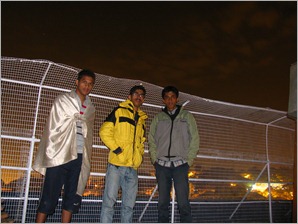
And there we were, the three of us, me, Anmol and Omkar Borkar who had decided to brave the cold nights of December to catch a glimpse of this amazing annual display called Geminds!
Getting a little technical, the Geminids have a radiant lying just besides Castor, one of the heads of the twins in the constellation Gemini. This shower is said to be the 2nd most consistent meteor shower annually, after the Persids and has garnered a lot of attraction from astronomy fanatics this decade due to the rise in its activity which is caused due to the remains of comet 3200 Phaethon in the the orbit of the Earth around the sun. The expected peak rates for India ranged from a 60-140 ZHR. But, as we were to observe form a location affected by light pollution, we expected much less of a show. The last time I had stayed back for a shower, I had seen only 15 meteors through-out the whole course of observation throughout the night, that being the 2009 Quadrantid shower.
As I was leaving home, I just managed to message a schoolmate of mine, Riya Borkar that there was shower happening tonight as I knew she was very much interested in astronomy and incidentally one can see her window from the Observatory, and thus ensued a round of crazy gesturing to her to communicate to her the general direction to look up to. I was really glad to see people getting interested in such events, by looking at the number of updates posted about the shower on Facebook. But now, was the time for the show to begin!
After a quick tour through a few Messiers, we settled down, our heads making an angle of 120° with each other. As the show began, we realize d that we would get much more than expected!!!
Our main motive being to enjoy the shower, we didn’t give much strain on carrying out a detailed observation nor photography due to the lack of manpower, but did not forget to make a mention of every meteor that we observed, with respect to its path and magnitude. For an hour or so, we had to face the extreme. From a period of a few meteors in a minute to a dry spell of about five minutes, we had to face it all! But, with the true spirit and patience of an amateur, we sang and talked our way, perhaps just to make sure that we do not doze off!
After a short break and a tally, we concluded that the plan was a success and truly worth all the hassle taken! Most of the brighter meteors ended up in the constellations of Orion, Canis Major, Canis Minor and Auriga, with Gemini not far behind. During the next spell, the mercury dropped even lower, making way for the chilly winds. Although the magnitudes of the meteors ranged from -3 to 4, we did no distinct fireballs or Bolides were observed, but that is very much typical of the Geminds. By that time we had a tally of 121 meteors, and that number would be good enough to last me for a few lifetimes, to put it straight! This was our first major shower observation, and the number of ‘WOW’s would have made our mood very clear to you, if you had graced your presence!
Unfortunately, at about 2:25 am, due to the wind-speed, we had clouds moving in slowly and thus forcing us to cut short our observation, almost half-way!! Although, this very news was disheartening, it could not overshadow the joy of seeing all those bright wonders, streaks of light that made my day! We wrapped up in a matter of minutes and despite being prepared to stay awake the whole night, we found more sense in sleeping under the table (employed some science in here) in the observatory room besides the terrace, thus ending another one of our crazy endeavours with an equally funny thing. Besides that, we also conducted observation of Venus and Saturn in the morning before leaving for our respected houses.
(Please note that we are planning to stay up for the Quadrantids on Jan 3rd or 4th, having the same rate as Geminids are expected, with the bonus addition of a new moon)
14th December 2010 would have passed of in my life as an another rather ordinary day, had it not been for some bouts of craziness that only astronomy can instil in oneself. Since a few years that I have been involved in amateur astronomy, this was one of the most fulfilling moments that I had. I was on duty at the observatory, a cold winter night promised me some of the usual delights of the sky including the awesome nebula in Orion and the Andromeda galaxy, along with a dazzling display by the Moon and Jupiter to brighten my day up. Little did I know, that there was a big thing waiting in line, down the horizon!
As me
 and my colleague and friend Anmol Naik let the visitors peep through the universe through the 5” telescope, we managed to catch a glimpse of a few meteors here and there, which aroused our interests. As an amateur, I am not supposed to forget stuff like prominent meteor showers, but that is what I did!! Realising that we had a good sky in hand, one of the best of the season, we decided to have a meteor watch the very next day after checking out the fine details of the event. But, confusion with time zones prevailed and this led to the chaos!
After resuming my usual internet browsing session at home that very night, I found to my horror that the shower was meant to peak at midnight. The very same night! Realizing that I had just a hour or two in hand, I pressed the panic button and started making frantic calls to my seniors and fellow observers to hatch a plan for observation. This started to look seemingly difficult to materialize as our seniors were just returning from a programme at Bondla. But after a few swings from one end to the other, we finally got the nod for the night!!!

And there we were, the three of us, me, Anmol and Omkar Borkar who had decided to brave the cold nights of December to catch a glimpse of this amazing annual display called Geminds!
Getting a little technical, the Geminids have a radiant lying just besides Castor, one of the heads of the twins in the constellation Gemini. This shower is said to be the 2nd most consistent meteor shower annually, after the Persids and has garnered a lot of attraction from astronomy fanatics this decade due to the rise in its activity which is caused due to the remains of comet 3200 Phaethon in the the orbit of the Earth around the sun. The expected peak rates for India ranged from a 60-140 ZHR. But, as we were to observe form a location affected by light pollution, we expected much less of a show. The last time I had stayed back for a shower, I had seen only 15 meteors through-out the whole course of observation throughout the night, that being the 2009 Quadrantid shower.
As I was leaving home, I just managed to message a schoolmate of mine, Riya Borkar that there was shower happening tonight as I knew she was very much interested in astronomy and incidentally one can see her window from the Observatory, and thus ensued a round of crazy gesturing to her to communicate to her the general direction to look up to. I was really glad to see people getting interested in such events, by looking at the number of updates posted about the shower on Facebook. But now, was the time for the show to begin!
After a quick tour through a few Messiers, we settled down, our heads making an angle of 120° with each other. As the show began, we realize
d that we would get much more than expected!!!Our main motive being to enjoy the shower, we didn’t give much strain on carrying out a detailed observation nor photography due to the lack of manpower, but did not forget to make a mention of every meteor that we observed, with respect to its path and magnitude. For an hour or so, we had to face the extreme. From a period of a few meteors in a minute to a dry spell of about five minutes, we had to face it all! But, with the true spirit and patience of an amateur, we sang and talked our way, perhaps just to make sure that we do not doze off!
After a short break and a tally, we concluded that the plan was a success and truly worth all the hassle taken! Most of the brighter meteors ended up in the constellations of Orion, Canis Major, Canis Minor and Auriga, with Gemini not far behind. During the next spell, the mercury dropped even lower, making way for the chilly winds. Although the magnitudes of the meteors ranged from -3 to 4, we did no distinct fireballs or Bolides were observed, but that is very much typical of the Geminds. By that time we had a tally of 121 meteors, and that number would be good enough to last me for a few lifetimes, to put it straight! This was our first major shower observation, and the number of ‘WOW’s would have made our mood very clear to you, if you had graced your presence!
Unfortunately, at about 2:25 am, due to the wind-speed, we had clouds moving in slowly and thus forcing us to cut short our observation, almost half-way!! Although, this very news
 was disheartening, it could not overshadow the joy of seeing all those bright wonders, streaks of light that made my day! We wrapped up in a matter of minutes and despite being prepared to stay awake the whole night, we found more sense in sleeping under the table (employed some science in here) in the observatory room besides the terrace, thus ending another one of our crazy endeavours with an equally funny thing. Besides that, we also conducted observation of Venus and Saturn in the morning before leaving for our respected houses.
 A time-lapse video of the Geminids sourced from YouTube
(Please note that we are planning to stay up for the Quadrantids on Jan 3rd or 4th, having the same rate as Geminids are expected, with the bonus addition of a new moon)
Subscribe to:
Posts (Atom)
